100 Gigabit 'unstoppable'
Friday, January 13, 2012 at 1:12PM A Q&A with Andrew Schmitt (@aschmitt), directing analyst for optical at Infonetics Research.

"40Gbps has even less value in the metro than in the core"
Andrew Schmitt, Infonetics Research
Friday, January 13, 2012 at 1:12PM A Q&A with Andrew Schmitt (@aschmitt), directing analyst for optical at Infonetics Research.

"40Gbps has even less value in the metro than in the core"
Andrew Schmitt, Infonetics Research
Tuesday, December 13, 2011 at 8:28AM Next-generation reconfigurable optical add/ drop multiplexers (ROADMs) will perform an important role in simplifying network operation but optical component vendors making the core component - the wavelength-selective switch (WSS) - on which such ROADMs will be based should expect a limited return for their efforts.
"[Component suppliers] are going to be under extreme constraints on pricing and cost"
Sterling Perrin, Heavy Reading
Thursday, July 7, 2011 at 5:56PM Gazettabyte spoke with Larry Schwerin, CEO of Capella Intelligent Subsystems, about the ROADM market, the company's plans following its latest funding round, and the idea of a WSS-on-a-chip.
The reconfigurable optical add-drop multiplexer (ROADM) market has been the best performing segment of the optical networking market over the last year. According to Infonetics Research, ROADM-based wavelength division multiplexing (WDM) equipment grew 20% from Q2, 2010 to Q1, 2011 whereas the overall optical networking market grew 7%.
“It’s the Moore’s Law: Every two years we are doubling the capacity in terms of channel count and port count”
Larry Schwerin, Capella
1x20 WSS,
Capella,
Gridless,
Infonetics,
ROADM,
SingTel,
Verizon,
colourless,
directionless in
CEO Interview
Print Article
Tuesday, August 10, 2010 at 10:15AM Briefing: Dynamic optical networks
Part 3: ROADM and control plane developments
ROADMs and control plane technology look set to finally deliver reconfigurable optical networks but challenges remain.
Operators are assessing how best to architect their networks - from the router to the optical layer - to boost efficiencies and reduce costs. It is developments at the photonic layer that promise to make the most telling contribution to lowering the cost of transport, a necessity given how the revenue-per-bit that carriers receive continues to dwindle.
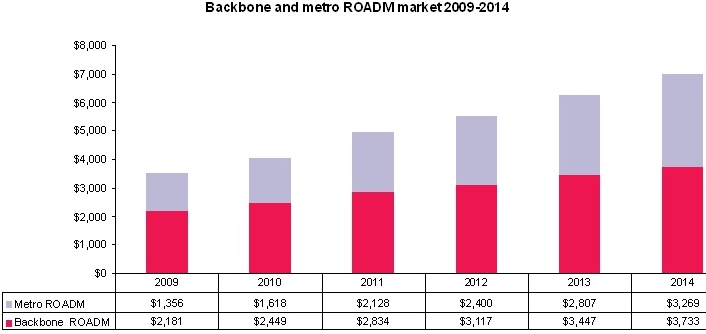
Global ROADM forecast 2009 -14 in US $ miliions Source: Ovum
Thursday, July 22, 2010 at 10:21AM The telecom industry is right up there when it comes to acronyms and complex naming schemes but it is probably no worse than other industries.
One only has to look at neighbouring IT and cloud computing in particular with its PaaS, IaaS and SaaS (Platform-, Infrastructure- and Software-as-a-Service).
But when it comes to agile optical networking and the reconfigurable optical add-drop multiplexer (ROADM), what is notable is the smarts that are being added and yet all are described using the “-less” suffix: colourless, directionless, contentionless and gridless.

These are all logical names once the enhancements they add are explained. But as Infonetics Research analyst Andrew Schmitt has pointed out, the industry could do better with its naming schemes. Even the most gifted sales person may be challenged selling the merits of a colourless, directionless product.